Some exercises look almost too simple to matter.
Step-ups are one of them.
They do not have the drama of heavy barbell squats. They do not feel flashy like jump training. They are rarely the star of a gym selfie. And yet, when done well, step-ups can be one of the smartest lower-body exercises for women who want stronger glutes, toned legs, better balance, and more functional strength for real life.
This is the kind of movement that trains your body in a useful, grounded way. You are not just moving weight. You are learning to produce force through one leg, control your pelvis, stabilize your core, and build strength that actually carries over into daily life — stairs, hills, getting off the floor, lifting kids, carrying bags, and training with better control overall.
What are step-ups?
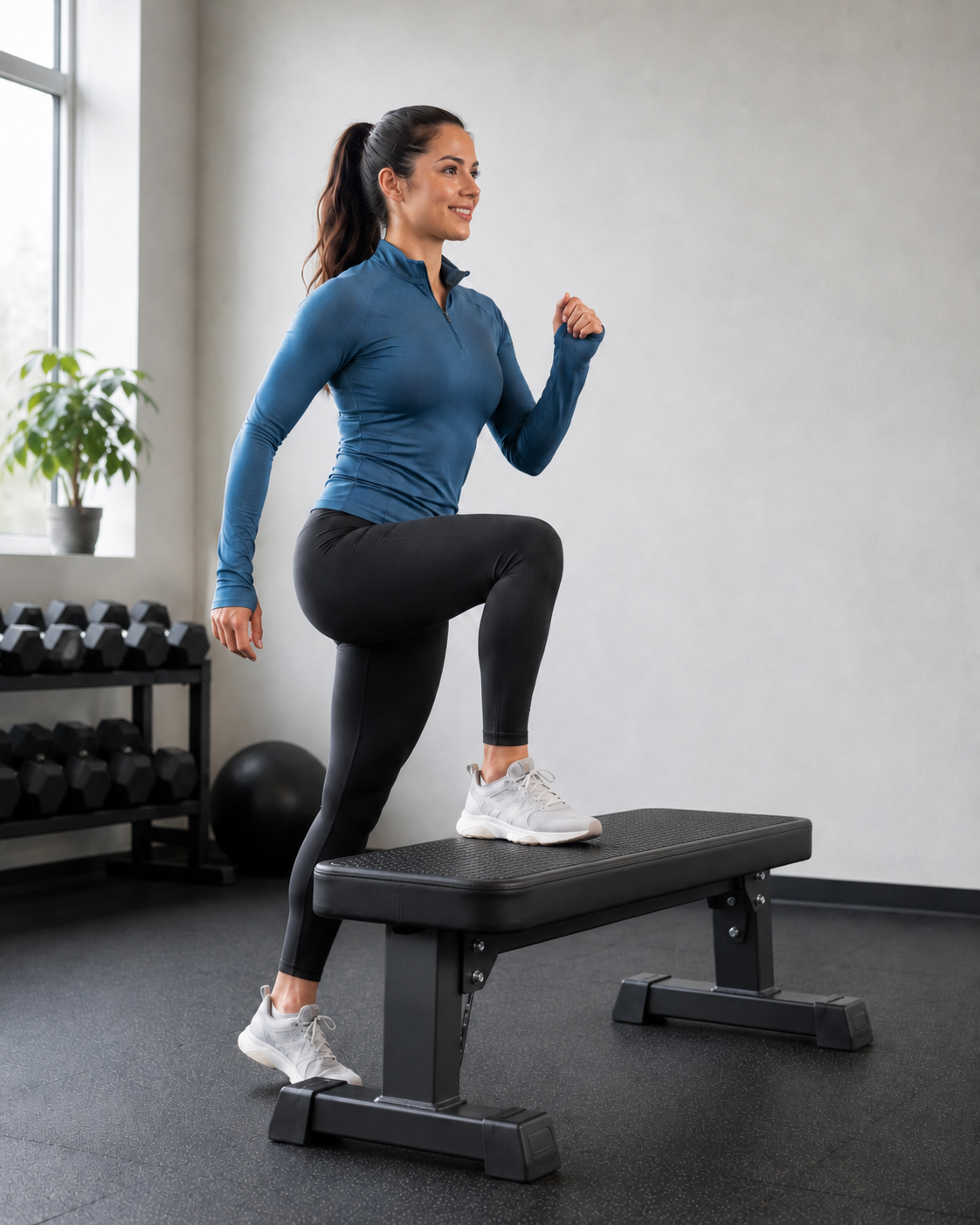
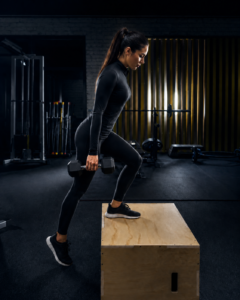
A step-up is exactly what it sounds like: you step onto a bench, box, stair, or platform using one leg, press yourself up with control, then return down.
Simple on paper. Very revealing in practice.
Because you are working one side at a time, step-ups can expose things bilateral exercises often hide — like relying too much on one leg, letting the knee cave in, pushing off the bottom foot, or lacking pelvic control. That is why step-ups are not just a “beginner move.” They are a serious training tool when programmed well.
Why step-ups deserve more respect
 1. They build real glute and leg strength
A good step-up lights up the lower body. Your glutes help drive hip extension, your quads help you rise up, and your hamstrings assist with control and support. Depending on the height of the step and how you perform the movement, you can bias the quads a bit more or ask more from the glutes and posterior chain.
2. They train one leg at a time
This matters more than many women realize.
Life is not perfectly symmetrical, and neither is your training. When you climb stairs, step onto a curb, or get up from the floor, one side is often doing more work than the other. Step-ups train that real-world pattern. They can also help you notice strength differences between sides, which is useful if one leg always seems less stable or weaker in lunges, split squats, or running.
3. They improve balance and control
Step-ups are not only about “legs.” They are also about stability.
To perform them well, you need to keep your pelvis steady, your foot rooted, your knee tracking with control, and your trunk organized instead of wobbling everywhere. That control starts deeper than most people assume — a lot of it traces back to core and pelvic floor strength working quietly in the background. That makes step-ups useful for women who want to feel stronger and more athletic, but also for women who simply want more confidence in their movement.
4. They are joint-friendlier for many women
Not every woman feels amazing with heavy barbell work, deep bilateral squats, or high-impact cardio. Step-ups can be a great option because they are easy to scale. You can adjust the height, tempo, support, and load. You can keep them bodyweight-only, or make them brutally effective with dumbbells and a slower lowering phase.
That flexibility makes them useful for home workouts, gym workouts, and many phases of life when you want strength work to feel challenging without feeling reckless.
What muscles do step-ups work?
A well-executed step-up mainly targets:
- Glutes
- Quads
- Hamstrings
- Calves
- Core stabilizers
Your supporting muscles also work hard to keep you balanced and aligned. That is one reason step-ups can feel more demanding than they look, and it’s part of why strong core stabilizers matter just as much here as the visible leg work.
Are step-ups good for glute growth?
Yes — especially if you stop rushing them.
Step-ups can absolutely support glute development when you use proper form, enough effort, and progressive overload. They are not a complete solution on their own, but they can be a valuable part of a glute-focused program.
If you want to make them more glute-friendly, think about:
- using a step height that allows meaningful hip flexion without losing form
- leaning the torso slightly forward naturally, not excessively
- driving through the full foot of the working leg
- controlling the lowering phase
- avoiding momentum from the bottom leg
- progressing load over time
A higher step can often increase the hip demand more than a very low one, but only if you still have clean form and pelvic control.
How to do a step-up with proper form
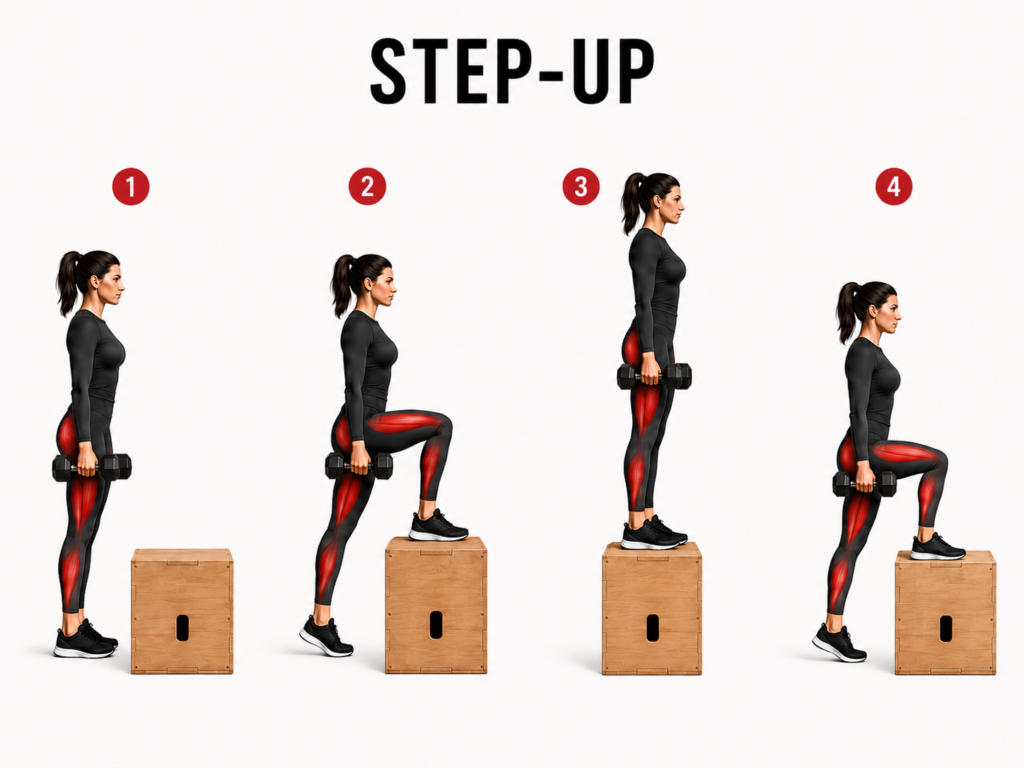 Here is the version I would teach first:
- Stand facing a sturdy step, bench, or box.
- Place one full foot on the platform.
- Brace your core gently and keep your chest tall.
- Push through the working leg to rise up.
- Bring the other leg up with control.
- Step back down slowly.
- Repeat all reps on one side, then switch.
Step-up form cues that actually help
Think:
- “Push through the leg on the box.”
- “Do not bounce off the floor.”
- “Keep the knee tracking over the foot.”
- “Stay tall through the torso.”
- “Control the way down.”
- “Own the top position.”
The biggest mistake? Turning step-ups into a sloppy climb where the bottom leg does half the job.
If the trailing leg is pushing you up aggressively, your working leg is not getting the training effect you think it is.
Common step-up mistakes
Using a box that is too high
Higher is not always better. If your pelvis twists, your spine rounds, or you have to launch yourself upward, the setup is too aggressive.
Pushing off the bottom foot
This reduces tension on the working leg and turns the movement into a cheat rep.
Letting the knee cave inward
That usually signals poor glute control, poor foot stability, or a load you are not controlling well.
Dropping down too fast
The lowering phase matters. Slow eccentrics build control, strength, and better movement quality.
Treating it like cardio only
Step-ups can raise your heart rate, yes. But if your goal is muscle and strength, do not rush through them mindlessly.
Best step-up variations for different goals
Basic bodyweight step-up
Perfect for beginners, home workouts, or rebuilding movement quality.
Step-up with knee drive
Great for balance, athletic control, and extra hip flexor and core involvement.
Dumbbell step-up
A strong choice for muscle-building and progressive overload.
Lateral step-up
Useful for changing the stimulus and challenging frontal-plane control.
Slow eccentric step-up
Excellent when you want more control, more time under tension, and less ego.
Front-loaded step-up
Holding dumbbells at shoulder level or using a goblet hold can increase core demand.
Are step-ups better than squats or lunges?
Wrong question.
They are not necessarily better. They are useful in a different way.
Squats are excellent for bilateral strength. Lunges are fantastic for unilateral control and mobility. Step-ups offer something special too: single-leg strength with a very functional pattern and a setup that many women find easier to learn than lunges.
A strong lower-body program often includes a mix of all three.
If someone hates lunges, feels unstable with them, or wants a lower-body move that feels more intuitive, step-ups are often a smart alternative.
Who should include step-ups in their workouts?
Step-ups can be great for:
- women building glutes and legs
- beginners learning lower-body strength
- women training at home with minimal equipment
- women who want functional fitness
- women working on balance and coordination
- women who want lower-body training without high-impact jumping
They can also be useful in phases where controlled strength feels more supportive than flashy intensity.
A simple way to program step-ups
For general lower-body strength:
3 sets of 8 to 12 reps per side
For glute and leg hypertrophy:
3 to 4 sets of 8 to 10 reps per side with load
For control and stability:
2 to 3 sets of 6 to 8 slow reps per side
For conditioning:
shorter step, lighter load, timed intervals with clean form
If you’re training around fatigue, a busy week, or recovering from something else, this is also a movement that fits well into a smarter, more sustainable approach to training load.
Final thoughts
As an ISSA Certified Personal Trainer, I like step-ups because they build real lower-body strength, improve balance, and translate well to everyday movement. They are one of those exercises people underestimate until they do them properly.
They can humble you quickly. But that is part of their value.
They ask for strength, control, coordination, and honesty. They can reveal imbalances, sharpen movement quality, and help women build stronger glutes and legs without needing complicated programming. And for many women — especially those who want smart, effective training that supports everyday life — that makes them incredibly worth keeping.
Not trendy. Not overrated. Just effective.
If you want an exercise that is simple, scalable, glute-friendly, and highly functional, step-ups deserve a place in your routine.
Start lower than your ego wants.
Move slower than your instincts want.
Own every rep.
Then progress.
That is how “basic” exercises become powerful.
Want more form breakdowns, glute-focused programming, and exercise deep-dives like this one? Follow along on Instagram @healthyhabitsexplorer for the visuals that make this stuff click.
**This article is for educational purposes only and is not intended as medical advice. Always consult a qualified healthcare provider or certified professional before starting any new exercise program, especially if you have an existing injury, joint condition, or are pregnant or postpartum.