
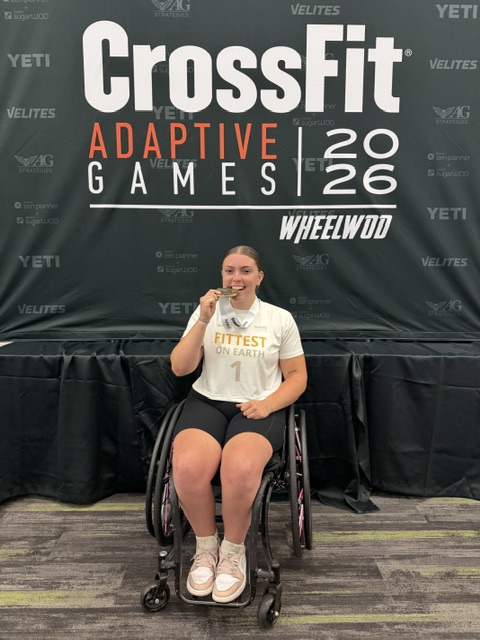
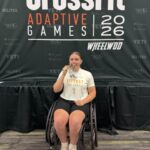
At just 20 years old, Hope Kittel is already a two-time Fittest Seated Woman on Earth — a title she never imagined she would one day hold.
Just three and a half years ago, her life looked completely different. In March 2023, a rare neurological event left Hope quadriplegic, forcing her to navigate a new reality and rediscover what independence could look like for her. What followed was not a journey she had planned, but one that would eventually lead her into adaptive CrossFit, onto the CrossFit Games podium, and toward a strength she was only beginning to discover.
Today, Hope lives in Wisconsin and continues to push the boundaries of what she once believed was possible — in sport, in everyday life, and in the way she sees her own body.
But Hope is much more than her achievements in sport. She describes herself as a Christian, a friend, a nonprofit owner, a chosen aunt to three children, a speaker, a coach, and a future author. She has recently finished the manuscript for her first memoir, where she shares the journey of losing so much of who she thought she was, discovering who she could become, and learning that life can be incredibly difficult while joy can still be very real.
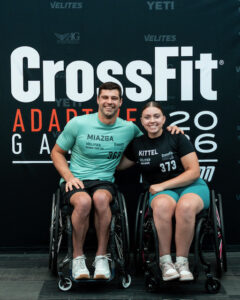
Her introduction to adaptive CrossFit came around two and a half years ago through Tom Miazga, who had been one of the swim coaches at her high school. Tom is a 10-time Fittest Seated Man on Earth, Paralympic swimmer, HYROX World Champion, and Ironman. He invited Hope to visit the CrossFit gym where he trained, and from that first visit, she fell in love with the sport.
For Hope, functional fitness opened her eyes — and her life — to a level of independence and control she had not known before. It gave her a new way to see what her body could do and what might still be possible. The community became just as important. She found people who showed up for one another inside the gym and beyond it, and who made her feel part of something from the beginning.
She remembers those first days being intimidating. Watching other athletes lift heavy weights and move so well made her very aware of how much she still had to learn. Yet she never felt unwelcome. Her coaches and fellow athletes chose to include her, challenge her, and encourage her — something Hope credits as a huge part of why she kept going and eventually reached the highest level of her sport.
Competing was never the plan. Hope hesitantly agreed to enter the CrossFit Open, the first stage of qualification for the CrossFit Games, and won. What began with simply learning how to train in her body grew into something far bigger. Step by step, she kept showing up, kept learning, and kept discovering what she was capable of — all the way to becoming the Fittest Seated Woman on Earth, twice.
In this HerStory, Hope takes us behind the title and shares the journey, training, mindset, and community that shaped the athlete she is today. She opens up about adaptive CrossFit, recovery, coaching, accessibility, and the lessons she has learned about strength, independence, and resilience along the way.
For someone discovering it for the first time, how would you describe adaptive CrossFit? How are movements adapted or scaled for a seated athlete while still allowing you to build strength, challenge yourself, and progress? What do you wish more people understood about adaptive athletes?
Adaptive CrossFit is the practice of completing varied endurance and strength movements across broad time domains, and to me, it is one of the best simulations of everyday life. CrossFit is the reason I can get from the floor back into my wheelchair, reach up and grab a box off a shelf, or get into my car independently.
People often confuse the words “adaptation” and “scaling.” For elite adaptive CrossFit athletes, our bodies are still being demanded to complete difficult tasks just as any able-bodied athlete would. My deadlift may not include leg drive, and my clean may not include the same hip extension, but that doesn’t make either movement any less difficult.
The majority of my workouts involve my arms, but I rotate between pushing, pulling, and core work to make sure I’m training all of the muscles I have access to. The movements may look different, but the goal is the same: to challenge myself, get stronger, and continue progressing.
I wish more people understood that adaptive athletes are athletes first, not billboards for inspiration. We may be inspiring while we compete, but the goal isn’t to collect pity from others. There’s also a misconception that what we do is somehow less difficult than what able-bodied athletes do, and that is blatantly untrue. We aren’t asked less because of our disabilities, and there are no participation trophies. We are still expected to work hard, push our limits, and earn our results.
What does your training look like in a typical week — strength work, conditioning, skill work, and training frequency? How do you and your coaches approach progression, and does your programming change when you’re preparing for competition?
I work out six days a week for 2–3 hours a day. I’ve always attended the group fitness classes at my gym because, to me, the community aspect is essential to staying disciplined and continuing to love what I do.
My training changes depending on what I’m working toward — whether that’s the CrossFit Games, a 2.62-mile walk, pushing toward a half marathon, or training for HYROX. Right now, as I approach my marathon walk attempt, my training has had an especially intense focus on building my abs and triceps. After that, I’ll continue building my endurance by adding more long pushes and longer cardio pieces into my training.
Once spring arrives, I’ll shift my focus again and go through another intense weightlifting program to maintain the strength I’ve built and continue adding to it before the CrossFit Games.
I also work with a variety of coaches, each of whom sees different aspects of my training that I can improve. With every additional set of eyes, I’m able to learn something different, and that variety continues to push me forward toward becoming a better athlete — both mentally and physically. My programming evolves with my goals, but the constant is always progression: finding the next thing I can improve and figuring out how to adapt my training to get there.
You went from training with five-pound dumbbells to becoming the Fittest Seated Woman on Earth — twice. What were some of the biggest turning points in that transformation, and how has becoming physically stronger changed your confidence, independence, or everyday life?
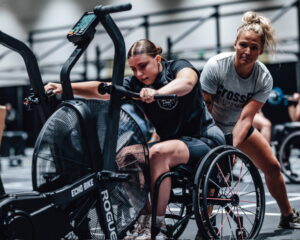
I think there were two really significant turning points in that transformation. The first was realizing that I actually had a place in this world of fitness. When I first started, I was using five-pound dumbbells and trying to figure out what movement even looked like for my body. I didn’t see a lot of people who looked like me doing the things I wanted to do, so it was easy to believe that maybe I just didn’t belong. Then meeting Tom, he told me something that completely changed the way I saw myself: “If you have a lane, you have a chance.”
I started to realize that I didn’t need to fit into someone else’s version of fitness. I needed to find my lane and figure out what was possible from there. That shift—from asking “Can I do this?” to “How can I do this?”—changed everything. Eventually, that five-pound dumbbell became a 125-pound bench press, and the girl who was just trying to figure out how to move became the Fittest Seated Woman on Earth.
The second turning point was realizing that I had to take radical responsibility for my own independence and strength. After becoming quadriplegic, there were so many things I genuinely needed help with. But I also realized that if I wanted to build the life I wanted, I couldn’t wait for someone else to make me independent. I had to work toward it—physically, mentally, and emotionally.
Getting stronger in the gym gave me more than muscle, it gave me evidence of what was possible. Every time I learned a new movement, lifted something I didn’t think I could lift, pushed myself through something uncomfortable, or accomplished something that once seemed impossible, I was proving to myself that I was capable of more than I thought. That confidence started spilling into everything else.
I became more willing to try things, advocate for myself, ask for what I need, and take up space. Strength gave me a different relationship with my disability. I stopped seeing my body only through the lens of everything it couldn’t do and started seeing it for everything I could teach it to do.
And I think that’s probably the biggest transformation of all. The goal was never really just to become the Fittest Seated Woman on Earth. It was learning that I had a lane, that I belonged in it, and that I was responsible for seeing just how far I could take it.
Community seems to be such an important part of your story. How have your coaches, fellow athletes, and the people around you influenced your journey and the athlete you’ve become?
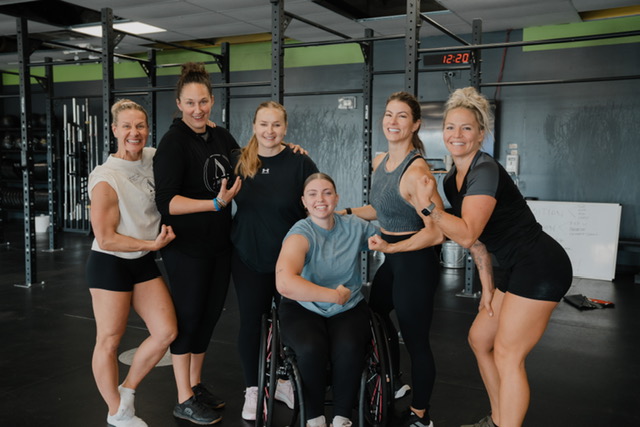 Community is probably one of the most important parts of my story because these are the people who taught me to have radical belief in myself.
The first person who did that was my athletic trainer, Carly. She took care of me through some of the hardest parts of my recovery and ultimately introduced me to Tom. From there, it was people like my training partner Alyssa, people who showed up to my competitions like Amanda and Kelley, and more recently, people like Kaitlyn, Cari, Claire, and Liv. Those are just a few of the dozens of people who have played massive roles in my fitness career.
But for most of them, their impact on my life has gone far beyond the gym and far beyond what they have helped me physically accomplish. They have been my biggest cheerleaders. They have made sure I had help when I was in a really difficult place mentally. They have sat with me in church through seasons of grief. They have fed me dinner. They have shown up, over and over again, in the moments when I needed people the most.
No one can do the work for me. I still have to be the one who shows up to training, pushes through the hard days, and gets under the bar. But these people have helped create the foundation that allows me to give everything I have when I walk into a training session or onto a competition floor.
I think that’s what community has taught me: resilience isn’t a one-person job. I may be the one doing the work, but I don’t have to do it alone. The people around me have given me something just as valuable as physical strength—the belief that I am capable of more than I can see for myself sometimes. And when you have people who believe that fiercely in you, eventually, you start believing it too.
You’re also CrossFit Level 1 (CF-L1) certified. What inspired you to take that step, and how has learning more about coaching influenced the way you approach your own training and helping others?
Getting my CF-L1 came from a little internal mantra I have: “Don’t gatekeep what changed your life.” In today’s society, there can be a tendency to hide the thing that changed your career, made you stronger, or launched your success in whatever area it may be. I refuse to play into that.
Functional fitness gave me my life and independence back. That may be because my origin story is in a wheelchair, but for someone else it could mean fighting against generational habits, recovering from a high school injury, or navigating a different type of disability. I want to make fitness as accessible and approachable as possible for as many clients and members of the gym as I can.
Coaching has taught me the intentionality behind every movement and that, ultimately, the best coaches are the ones who leave you with something beyond the class itself. That might be a stretch for a tight neck, a tip for strengthening a stubborn shoulder, or a mobility exercise that makes squatting easier so someone can pick up their grandchild from the floor.
Most importantly, I’ve learned that everyone learns differently, but everyone who walks into my class is there because they want to become even the slightest bit better. Coaching has changed the posture in which I carry myself. So many people have cheered for me, believed in me, and supported me throughout my journey. Now I have the opportunity to be that person for someone else — and I don’t take that responsibility lightly.
How do you support your health and performance outside of training? Are there any nutrition, recovery, sleep, mindset, or other daily habits that have become especially important to you?
I can only train as hard as I recover. Although I may be 20 years old, having a disability means I have to be especially cautious and intentional about how I take care of my body. Stretching, physical therapy, hot and cold showers, sleep, and nutrition all play a role in that.
It’s the less glamorous side of being a high-level athlete, but without proper fuel and rest, I’m asking my body to complete a NASCAR race with zero fuel. Recovery isn’t separate from my training — it’s what allows me to continue training at the level I do.
Mindset matters a huge deal, too, because most days I’m not motivated. I’m exhausted, stressed, overwhelmed, or some combination of all three, and I still choose to show up. Discipline is vital. If I’m still holding onto the dream, then I should still be willing to chase it on the days I don’t want to put in the work required to get there.
At the same time, I’ve learned that taking time away from sport and allowing myself to simply be a person is part of what gives me the capacity to keep pushing through the hard days. I love what I do, but I am more than an athlete. Making space for other people, activities, and parts of my life has been just as important to my longevity as the work I put in inside the gym.
For a woman who uses a wheelchair and wants to start getting stronger but doesn’t know where to begin, what advice would you give her? And if she eventually wants to try adaptive CrossFit, what should she look for in a coach, gym, or community?
In my experience, the fitness world is much more inclusive than it may seem — especially CrossFit. The community is unmatched, and if you are willing to give people the opportunity to learn, make mistakes, and figure out how to best support you, you can go incredibly far.
Adaptation is incredibly individual. My movements aren’t going to look the same as someone else’s, even if we have the exact same impairment. That’s why I would encourage someone to find a coach who is willing to listen, ask questions, and learn alongside you rather than assuming they already know exactly what you need.
It will be intimidating at first, and there is absolutely a learning curve. But you don’t need to enter a gym already knowing how to adapt every movement. Find a community that makes you feel welcomed, challenged, and supported, and then give yourself permission to learn.
My messages are always open to advice, and through my social media pages, I’ve been incredibly honored to help other people with disabilities find gyms and communities near them. If you’re considering taking that first step, reach out. You don’t have to figure it all out by yourself.
From my experience, rediscovering fitness can feel intimidating, but it is a drop in the bucket compared to the things I’ve already overcome. You are capable of more than you probably realize — and you won’t know what’s possible until you give yourself the chance to find out.
From your experience as both an athlete and a CF-L1 trainer, what do you think gyms, coaches, and the wider fitness industry could do better to make fitness more accessible and welcoming for women with disabilities?
I think the biggest thing gyms, coaches, and the fitness industry can do is stop assuming that accessibility means lowering the standard. Accessibility isn’t about asking less of an athlete; it’s about finding a different way to ask them to do something.
As coaches, we need to be willing to look at the intended stimulus of a movement and figure out how we can create that stimulus for the individual in front of us. That requires listening, asking questions, and being willing to learn. There isn’t a universal “adaptive version” of a movement because disability is incredibly individual. Two women with the same diagnosis may need completely different adaptations.
I also think gyms can do a better job of making inclusion visible. When someone with a disability walks into a gym and sees that there are people like them already training, competing, and being treated like athletes, it changes what they believe is possible. Accessibility also means considering the physical space, equipment, communication, and the attitude of the people in the room.
Most importantly, I want women with disabilities to be challenged. Sometimes inclusion can unintentionally become a form of exclusion when people are so afraid of making a mistake that they stop challenging the athlete altogether. I would much rather have a coach say, “I don’t know, but let’s figure it out together,” than decide what I can or cannot do before I ever get the chance to try.
I’ve been incredibly fortunate to have coaches and communities that chose to include me, challenge me, and believe in me. Now, as a coach myself, I see it as my responsibility to do the same for the next person who walks through the door. Fitness should be a place where women with disabilities aren’t simply accommodated — they are expected to grow, challenged to improve, and given the opportunity to discover what they’re capable of.
You’ve spoken openly about going through a very difficult period in your life. If you’re comfortable sharing, what helped you through that chapter, and what did it teach you about resilience and your own strength?
I think what helped me through that chapter was realizing that survival is not a one-person show. There were so many moments when I didn’t have the strength to believe in myself, so I had to borrow the belief that other people had in me. My family, friends, coaches, the people in my gym, and so many people who simply chose to show up for me became the hands that held onto me when I didn’t know how to hold onto myself.
I also had to learn that resilience doesn’t always look like being strong. Sometimes resilience looked like getting out of bed. Sometimes it looked like going to therapy, getting in my wheelchair, showing up to the gym, or simply making it through another day. I used to think strength meant never wanting to quit. Now I understand that sometimes strength is wanting to quit and choosing to take one more step anyway.
That chapter taught me that I am capable of surviving things I never would have chosen and never could have imagined. It also taught me that I don’t have to do it alone. The people and things I love have become bonds in my life that have only grown stronger under pressure.
I don’t think resilience means that life stops hurting. I think it means learning how to carry the hurt without allowing it to convince you that there is nothing beautiful left to carry it for. I have learned to hold the truth that life can be incredibly difficult and joy can still be incredibly real — and for me, that has become one of the greatest lessons of my life.
Looking Ahead
Becoming the Fittest Seated Woman on Earth — twice — is an incredible achievement. What does that title mean to you today, what are you most proud of when you look back at your journey, and what are you excited to work toward next?
The title means something very different to me today than I think it would have three years ago. Becoming the Fittest Seated Woman on Earth twice is something I am incredibly proud of, but the title itself isn’t the thing I’m most proud of. I’m most proud of the person I had to become to earn it.
When I look back, I see a girl who never thought she would compete, who was intimidated entering a gym, and who had no idea what her life was going to look like after becoming a quadriplegic. Somehow, that same girl went from pressing five-pound dumbbells in rehab to sitting on a CrossFit Games podium twice. The medals are incredible, but they are evidence of everything that happened in between — the failures, the setbacks, the people who believed in me, and all of the days I showed up when I didn’t want to.
Being Fittest Seated Woman on Earth has also given me a platform that I don’t take lightly. I want people to see the title and then look beyond it. I want a young woman with a disability to see me and think, “Maybe I can do that too.” I want people to understand that disability can change your life without deciding what the rest of your life gets to look like.
As for what’s next, I don’t think I’m very good at sitting still. Right now, I’m focused on my 2.62-mile marathon walk attempt and continuing to build my endurance. Beyond that, I’m excited to keep getting stronger, pursue new challenges like HYROX and a half marathon, continue growing as a coach, and eventually getting back onto the CrossFit Games floor.
I don’t know exactly what the next title will be, and honestly, that’s part of what makes it exciting. I just know I’m not done finding out what this body and this life are capable of.
To End This HerStory… ✨
I asked Hope to finish one final sentence:
“I want my story to remind women that…”
“Life can change in ways you never imagined, but there is still so much life, joy, and purpose waiting on the other side of what you thought was the end.”
It feels like the perfect way to close her story — a reminder that even when life takes a direction you never expected, it does not mean everything beautiful is behind you. There can still be joy, purpose, strength, and an entirely new chapter waiting ahead.
Connect with Hope Kittel
If you’d like to follow Hope’s journey, keep up with her training, or learn more about her work, you can find her here:
Instagram, Facebook & TikTok: @hopekittel
Book fundraiser: hope.ripples.media